
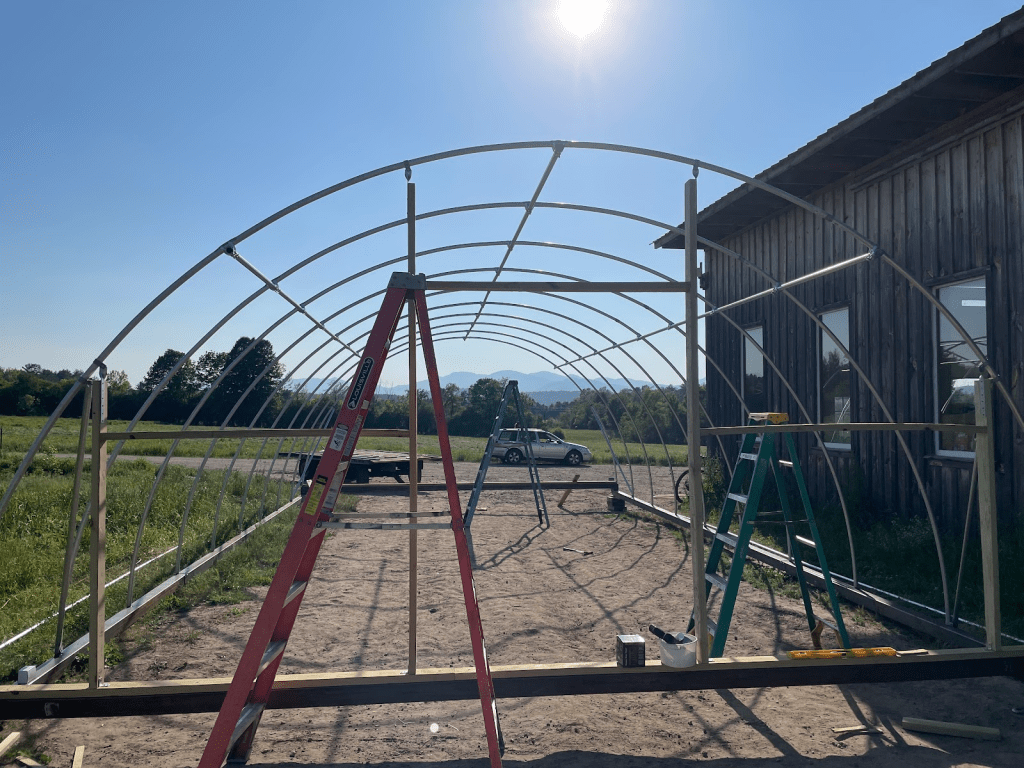
The last few days of May this week felt like summer. There is always the surprise sunburn on my ears as the sun comes out and I spend long hours in the sun and this year the burn and peel cycle felt earlier than normal. On Wednesday of this week John, Tully and I started in the cool of the morning with vests and extra layers. By 10 am we were sweating. Tully and I joked with each other about the sunburn on our ears, and John, with the flourish of a trained magician, pulled a half empty tube of sunscreen from his back pocket.
We gooped our ears with sunscreen and headed back to keep at building our 3rd of 4 new MRCs. Rarely do we have a building project that involves so much repetition. So often I finish a building project and I think to myself: if I were to do this again I would…This week we are really reaping the benefits of repetition.
Simple things, when done in advance, make the building easier in later stages. A few examples are:
- We have learned to level the frame before building the end walls so we can use levels to make our door frame square.
- Marking the pipe before bending the hoops so we can keep the purlins straight and properly spaced.
- Saving measurements from the previous coop for quick and easy cutting.

Of course there is practice too. We’ve done this before, just last week, and we know what to do. The first MRC took us almost two weeks to complete, the third one will be completed in less than 7 days. It is satisfying work albeit maybe too hot for our bodies still adjusting to the warm weather.
Pictured above are John and Tully fastening the “purlins” which run perpendicular to the hoops. Using hoop house fittings meant for vegetable farmers, we install these nifty “brace bands” which loop over the hoops and around the purlins and we sinch them down with carriage bolts. They provide great structural rigidity and strength to the structure as well as a place to hang feeders.
In our moments of feeling like a well oiled MRC production machine, Tully and I have hatched a business idea: could we sell instructions on how to coop builds? Complete with all my spreadsheets for ordering, how many supplies to order from which vendor. What do you think of that idea?

There have been a few subtle, and hopefully impactful design improvements on our new generation of MRCs. Shade and keeping the birds cool on hot summer afternoons is one area where we are hoping to make a difference. The new strategy involves painting the inside of the MRCs.
In our first really hot afternoons of the season I was interested to see if a new shade strategy was any better than our previous strategies. As you can imagine all animals seek out the cool of shade on a hot afternoon. We make sure that humans, cattle and pigs all have easy access to this. Chickens, however, must rely on the shade of their shelter in the field.
Our first generations of shelters just had tarps or metal roofing. One of the first things we noticed was that the chickens favored one of our coops that had a blue tarp over coops with white tarps. I remember thinking, wouldn’t a dark colored tarp be hotter?
On our first generation of MRCs I purchased shade cloth from a greenhouse supply place to add shade to the coops. This seemed to work better than no shade cloth, but it still felt too hot. In talking with other friends and mentors this winter I learned that lots of folks use a dark gray paint on the inside of the coop to reflect solar heat. White tarp with a dark interior provides shade and holds less solar heat. Shade cloths for our MRCs are expensive, so I was eager to try the paint idea to save money and hopefully offer better shade to the chickens.
I asked our neighbor Jay if he had any extra paint. Jay is a science teacher at our local school and a builder, musician and dear friend. Jay is the friend I go to when I am trying to reuse and recycle. My first instinct was to save time and order a few gallons of paint from our supplier, then Racey suggested there were probably many half full gallon pails of paint languishing in basements nearby.
Sure enough Jay brought over a box of paint he had been saving. My request was just enough of a push to purge his collection. I learned that most paint stores will “tint” or add coloring for free. So I got some black tint and started mixing.
I know Jay’s house well, and I took a trip down memory lane to remember the old living room wall colors, accent colors and a whole lot of light green that I didn’t recognize. I wondered to myself what stories accompanied these cans of paint. Now they were living a second life as shade for our chickens.
As I painted the white vinyl tarp the light inside the coop softened and it seemed cooler. As I finished painting, walking in and out of the coop to wash brushes and rollers, I could feel that slight relief, like walking under a big tree on a hot day. Relief is a good sign the paint was doing its job. Thanks Jay.

On our hottest afternoons, we will often check on our animals to make sure they have shade and water. Initial test results would suggest that the new coops with higher ceilings, top vents and painted covers offer more shade to the chickens. Incremental improvements!
 Reber Rock Farm Blog
Well done! Your efforts to make animals safe and comfortable is admirable! so is neighbors helping neighbors…and so are all of you for all you do there on your farm!
LikeLike