On Saturday our friends at Essex Farm hosted a farm auction. For those of you who have never sold or purchased anything through a farm auction it is like no other social gathering that I have experienced. Many folks go to an auction just for fun. Auctioneers really rattle off prices with that sing-song voice you hear in the movies, waving and pointing. And there is really a subtle art to bidding with a slight nod of the head, or hand gesture. For those less interested in the iron and steel, it is, of course, a big social occasion. For me this was a great opportunity to clean up the farm and move along some equipment we were no longer using. It was also a nostalgic trip through the history of our farm.
Our farm began as a fully draft powered farm, which means we used draft horses instead of tractors. Our initial ambition was to be a horse powered grain CSA, so we plowed and prepared fields for crops like wheat for flour, dry beans, pop corn and sunflowers. Many dusty hours were spend behind a team of horses pulling a plow or disc preparing to plan our crops. I loved collecting old horse equipment and I still feel an intangible satisfaction working an implement that was manufactured before my parents were born.
As our farm evolved we moved away from plowing our rocky pastures and instead replanting them to perennial pastures for our cattle, chickens and pigs while our horses transitioned to working mostly in Chad’s logging business. The iron and steel settled back into the old familiar dirt as rust replaced the oil and grease of use. These relics of our farm’s past and of past farmers are difficult to let go. There is the nostalgia of their use, as well as my strong aversion to letting go of the past. This week the spell was broken. Mark Kimball (of Essex Farm) hosted a farm auction this Saturday to sell off all of their horse equipment and anyone was welcome to add to the auction. This inspired me to do some sorting, cleaning and purging.
I began pulling equipment out of the weeds to bring to the auction. As each creaking piece of history emerged I offered them to Benji, our Amish friend who runs our butcher shop. He was easily tempted by my low prices and in the end I only sent two items to auction, an old parts baler that was engine driven and a single row horse cultivator. Benji took the rest.
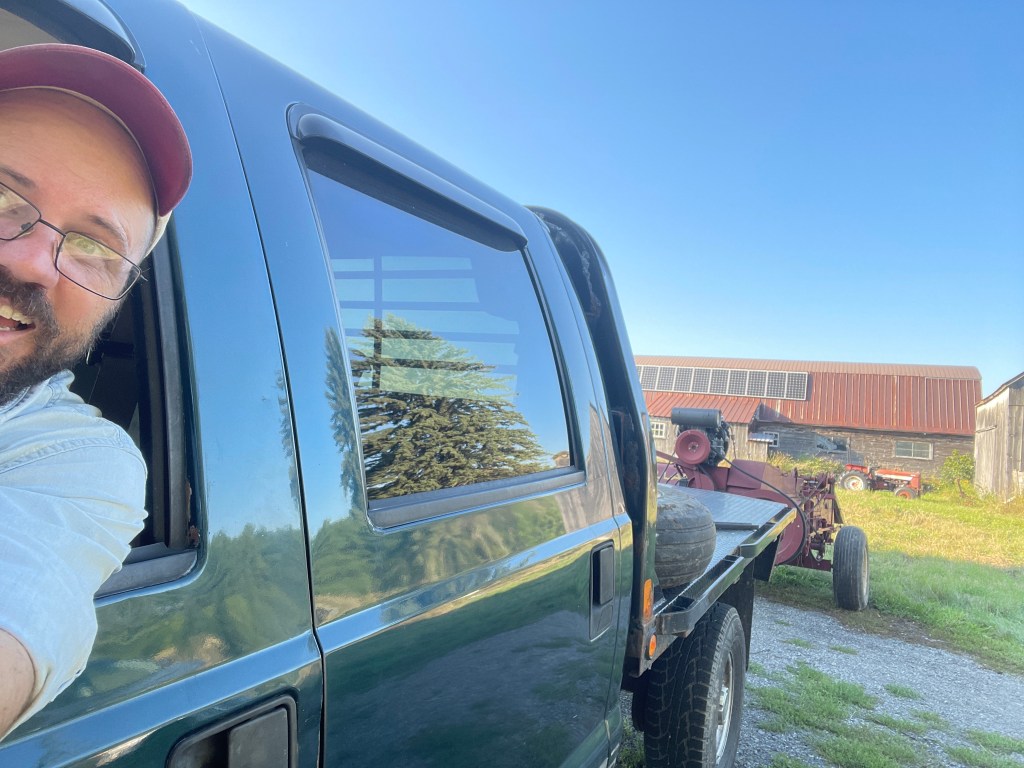
I pulled the baler down to Essex Farm with Chad’s truck, which involved scrounging a wheel off another piece of equipment, jacking the baler out of the dirt, putting on the borrowed wheel, and bumping down the road with the clank of steel and sheet metal behind me. This particular baler was our first hay baler, which came with steel wheels and an old Wisconsin engine to run the baler. Steel wheels are just what they sound like, a wheel made entirely of steel, and they make a racket going down a paved road. As I listened to the baler behind the truck I was brought back to nine years ago and our first summer making hay for our own farm. A warm afternoon, transporting the baler from our farm to Racey’s parents farm down the road and the many curious faces looking out doors and windows searching for the source of the incredible noise.

On the morning of the auction I had a few details to attend to on the baler, and as I tinkered and pounded on the baler to get a particular part to come loose, I was greeted by neighbors and friends as they came to the auction. I felt sad to give up these relics of the past, and happy to have the friends and neighbors that we do. There were even a few old friends that came up for the day to see the auction and say hello.
Why do we hold on to the physical, and perhaps the intangible memories of the past? Is it the comfort? Is it the security of knowing “what was” as compared to the unknowable “what will be?” I realized in the rhythm of the clanking steel wheel behind me that I hold onto the sense of self that comes with what you do and how you do it. A farmer, or at least my version, owns a cultivator and a parts baler, and what am I if not a farmer? In shedding the possessions of the past I wonder what the future will bring.

 Reber Rock Farm Blog
One thought on “The Clanking Rhythm of Change”