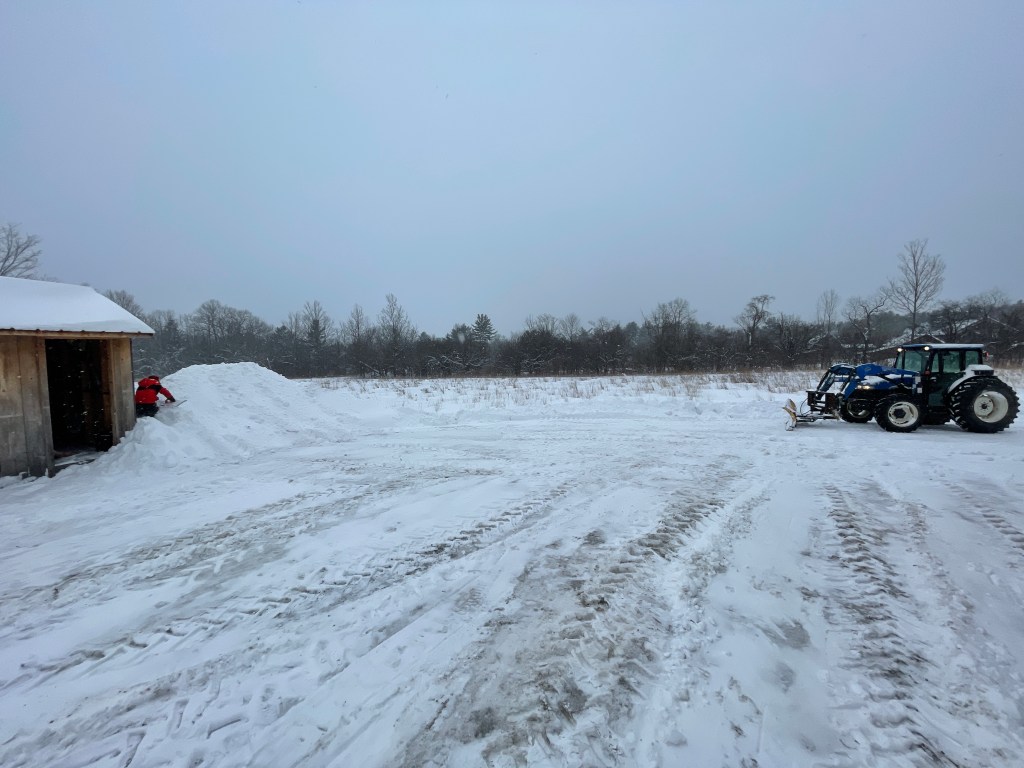
Snow days have changed for me over the years. As a child, they were spontaneous and unpredictable days of play and exploration, unfettered by the impositions of the reigning adult’s schedule. I grew up in Boston, where my memory says that snow days were rare enough that my brother and I never expected them, but always hoped. On rare snow days, I remember the frustration of the many plow and shovel operators not considering our snow building needs when depositing snow. As a young adult, snow brought fun mountain skiing, and also disappointment as well-laid plans were thwarted when snowy weather did not cooperate.
As a farm owner, snow is the great cleaner of the farm, cloaking all remaining messes in a blissful blanket. But, snow also makes just about any task longer and more difficult. Plowing adds cost and time to operations, and we’re still learning to remember, in November, to prepare for the weight and pressure that snow eventually brings, crushing anything we neglected to consider.
As Lewis approaches 7 years old, being a father in the snow has brought me full circle. We recently went for our first cross-country excursion as a family at Cascade Ski Center, followed closely by our first downhill skiing at Mt Pisgah. Most importantly I can finally curate the snow plow piles as I plow our driveway to maximize fort building and sledding/skiing/snowboarding and general snow playing.
February is a time of snow days, more sunlight and planning. I’ve been crunching the numbers, planning production scenarios and assessing how to adjust our prices to keep up with the steep rise in feed, and other costs.

Costs
Pricing is a difficult topic for me personally. I have considered many ways to talk about prices and costs and inflation, in the end I have decided to stay personal. Much of what we do and how we do it adds cost to our products. We feed certified organic feed, which often costs double what non-GMO or conventional feed costs. We purchase organic feed for our chickens and pigs because the ecological effects of our farming goes beyond our activities alone, there are many acres of land that are devoted to growing the grain to feed our animals, and we care about those acres. I feel torn between my responsibility as a business owner to keep costs and prices down for our customers, and my responsibility to both our farm ecosystems AND our customers to improve, not degrade, the world and animals that feed us.
Throughout 2021 we saw our costs steadily rise. As I sit and crunch the numbers on our production plan for 2022 and think about the future of our farm and business, I realize that at the heart of sustainability is the capacity to self sustain. The land must continue to thrive to produce the food, the food must continue to inspire customers to purchase, and the business must continue to support and provide for every individual who makes the business run. In simple business terms this means we need to make more money than we spend to keep moving forward.
What are our major costs and how have they changed? For chicken, beef and pork the majority of our costs are:
- Purchasing the young animal (chicks, calves, piglets) –> 25% increase.
- Feed (organic grain for pigs and chickens and just grass for the cattle) –> 30% increase.
- Slaughter costs –> 10% increase.
We work closely with our feed mill, hatchery, cow-calf producers, pig breeders and processors who are all raising their prices because costs are going up.
Pricing Plan
Here’s our road map for 2022 prices:
- We will raise prices to reflect our costs on March 1st.
- Prices for chicken and pork will go up 10% – 15%.
- Prices for beef will go up 5-10%.
We encourage you to stock your freezers over the next few weeks at 2021 prices!
I want to hear from you if you have questions, concerns or suggestions regarding pricing. Please email me at info@reberrockfarm.
 Reber Rock Farm Blog